Growth hormone secretagogues (GHS) are a broad family of compounds that provoke the somatotroph cells of the anterior pituitary to release endogenous growth hormone. Unlike recombinant growth hormone itself, a secretagogue does not supply the hormone; it acts upstream on the signaling architecture that governs when and how much growth hormone the pituitary secretes. For laboratories characterizing this pharmacology in vitro and in preclinical models, the field can look like an alphabet soup of overlapping abbreviations: GHRH, GHRP, GHS-R, CJC, MK, and a dozen more. This guide builds a clean taxonomy at 30,000 feet, then routes to the deeper cluster articles where each mechanism and comparison is dissected in detail.
The central organizing fact is that the somatotropic axis is governed by two distinct receptors acting through two complementary intracellular pathways. Almost every research secretagogue in circulation is a ligand for one of those two receptors. Grasping this dual-receptor architecture is the single most useful conceptual anchor a researcher can carry into the literature, because it predicts which compounds belong to which class, why certain combinations show additive or synergistic readouts in cell-based assays, and how selectivity and desensitization behave across repeated exposure. Everything that follows in this reference hub hangs off that framework. All material here is provided strictly for in-vitro and preclinical laboratory research; nothing in this article describes or implies human or veterinary use.
The somatotropic axis: two receptors, two signals
Growth hormone release from pituitary somatotrophs sits at the bottom of a hypothalamic-pituitary control loop. Two hypothalamic peptides pull in opposite directions: growth-hormone-releasing hormone (GHRH) stimulates secretion, while somatostatin (SRIF) inhibits it. Layered onto that classic model is a third input, the stomach-derived peptide ghrelin, which acts through its own pituitary receptor to amplify release. Research secretagogues are, in effect, synthetic tools that plug into one of the two stimulatory arms of this system. The inhibitory somatostatin tone is not a passive backdrop; its rise and fall sets the timing of natural pulses, and several secretagogue effects only become interpretable once a model accounts for where somatostatin sits in its cycle at the moment of stimulation.
The GHRH receptor (GHRHR)
The GHRH receptor is a class-B (secretin-family) G-protein-coupled receptor expressed densely on somatotrophs. When engaged by GHRH or a GHRH analog, it couples predominantly to Gs, elevating intracellular cyclic AMP and activating protein kinase A. In cell-based and pituitary-culture models, this cAMP/PKA arm is the pathway associated with promoting growth hormone gene transcription, somatotroph proliferation, and the readied release of hormone stores. Native GHRH is a 44-amino-acid peptide whose bioactivity resides largely in the N-terminal fragment, a structural fact that has driven the design of shortened, stabilized analogs studied in the literature. Because the transcriptional component operates on a slower timescale than acute release, GHRH-arm engagement is often assessed with two complementary readouts: an immediate second-messenger measurement and a longer-window measurement of hormone accumulation or message level.
The growth hormone secretagogue receptor (GHS-R1a)
The second receptor, GHS-R1a, is a class-A GPCR and the endogenous target of ghrelin. It signals through Gq/phospholipase C, driving inositol trisphosphate production and intracellular calcium mobilization. This Ca²⁺-dependent arm operates on a faster timescale than the cAMP arm and, in a distinct mechanistic wrinkle, also appears to blunt somatostatin's inhibitory tone. Adding to its complexity, GHS-R1a displays notably high constitutive (ligand-independent) activity in several expression systems, which means baseline signaling and inverse-agonist behavior become relevant experimental variables that have no real counterpart on the GHRH side. Because the two receptors recruit non-overlapping second messengers, compounds that engage them separately can be studied for additive or supra-additive effects when applied together. In the bimodal model of GH release, the GHRH arm raises cAMP and the ghrelin-receptor arm raises intracellular calcium on the same somatotroph, while the ghrelin arm also opposes somatostatin's inhibitory tone; together these explain why combined stimulation can exceed the sum of each alone. Demonstrating true synergy requires full concentration-response curves for each agent and a formal additivity reference, not a single combined point. The receptor-level pharmacology that separates these two targets, including binding kinetics and selectivity windows, is treated in depth in the dedicated GHRH receptor vs GHS-R1a selectivity analysis.
A working taxonomy of GH secretagogues
With the two-receptor scaffold in place, the entire research landscape sorts into three practical buckets. The first two are receptor-defined; the third is defined by chemistry rather than by a different target. A researcher can place virtually any named secretagogue into this grid within seconds once the receptor and the chemistry are known, and that placement immediately predicts the assay toolkit, the expected second messenger, and the likely duration behavior.
| Class | Primary receptor | Dominant signaling arm | Representative research compounds | Chemistry |
|---|---|---|---|---|
| GHRH analogs | GHRHR (class B GPCR) | Gs → cAMP / PKA | CJC-1295 (DAC and no-DAC), tesamorelin, sermorelin | Peptide (GHRH-derived) |
| Ghrelin-receptor agonists (GHRPs) | GHS-R1a (class A GPCR) | Gq → PLC / Ca²⁺ | Ipamorelin, GHRP-2, GHRP-6, hexarelin | Peptide (synthetic, non-GHRH) |
| Non-peptide GHS mimetics | GHS-R1a (class A GPCR) | Gq → PLC / Ca²⁺ | MK-677 (ibutamoren) | Small-molecule (orally studied) |
Class 1 — GHRH-receptor analogs
These are engineered descendants of native GHRH that retain the receptor-binding N-terminal domain while introducing substitutions that resist enzymatic degradation. The prototypical liability of native GHRH is rapid cleavage by dipeptidyl peptidase-4 (DPP-4) at the N-terminus, which sharply limits its persistence in solution and in vivo. Analog design has attacked this problem in two ways: point substitutions at the vulnerable residues, and, in the case of the DAC variants, a chemical handle that tethers the peptide to serum albumin to extend its window of activity.
Tesamorelin is a stabilized GHRH(1–44) analog carrying an N-terminal trans-3-hexenoyl modification that protects against DPP-4 cleavage. CJC-1295 exists in two studied forms whose distinction is one of the most consequential in this class: the no-DAC form (sometimes called modified GRF 1-29) is a tetra-substituted 29-residue fragment, while the DAC form adds a maleimido-proline "Drug Affinity Complex" that covalently binds albumin. That single structural addition transforms the half-life profile from short to markedly extended, a contrast dissected in the DAC vs no-DAC half-life comparison. Sermorelin, the GHRH(1–29) parent fragment, sits at the short-acting end of the spectrum and is frequently used as an unmodified reference point against which the stabilized analogs are compared. Because GHRH analogs act on the cAMP arm, they are frequently studied in combination with a ghrelin-receptor agonist that recruits the calcium arm.
Class 2 — ghrelin-receptor agonist peptides (GHRPs)
Growth-hormone-releasing peptides are short synthetic sequences that predate the discovery of ghrelin itself. GHRP-6 was the founding member; researchers identified its GH-releasing activity years before the endogenous ligand of its receptor was characterized, which is why the receptor carried the generic name "GH secretagogue receptor" before ghrelin was found to occupy it. The classic peptide GHRPs include GHRP-6, GHRP-2, ipamorelin, and hexarelin, and they differ meaningfully in potency, selectivity, and secondary pharmacology.
Ipamorelin is the most selective of the group and is often treated as the reference "clean" GHS-R1a agonist because, in preclinical characterization, it shows minimal cross-activation of the pathways that drive cortisol and prolactin release. That selectivity is measured in vitro by comparing GH release against ACTH, cortisol and prolactin readouts in pituitary or adrenal cell systems, and by binding and functional assays at GHS-R1a; the ipamorelin research overview covers the compound in detail. GHRP-2 and GHRP-6 are more potent GH-release triggers in many assays but are also associated with additional appetite-related and secondary endocrine signaling, a contrast laid out in the GHRP-2 vs GHRP-6 comparison. Hexarelin is the most potent of the classic GHRPs and is notable in the research literature for how rapidly it desensitizes the receptor on repeated exposure, along with GHS-R-independent activity at the CD36 scavenger receptor. CD36 binding is the reason hexarelin studies often include CD36-expressing and CD36-deficient comparison models, so that receptor-independent effects can be separated from GHS-R1a signaling. Its potency is contrasted with ipamorelin's selectivity in hexarelin vs ipamorelin.
Class 3 — non-peptide GHS mimetics
The third bucket shares the GHS-R1a target with the GHRPs but abandons peptide chemistry. MK-677 (ibutamoren) is the best-known example: a spiroindane small molecule that acts as a GHS-R1a agonist while being orally bioavailable and considerably more resistant to degradation than any peptide GHRP. In research settings it is valued precisely because its non-peptide scaffold gives it a very different pharmacokinetic profile from the peptide GHRPs, even though its receptor-level mechanism is broadly parallel to that of ipamorelin. It occupies the same conceptual slot as the peptide ghrelin-receptor agonists in the taxonomy above, and researchers frequently use it as a long-acting comparator against the short-acting GHRPs. Because it maintains near-continuous receptor occupancy, it also serves as a natural tool for probing what sustained agonism does to receptor sensitivity over time. The contrast with a peptide agonist at the same receptor is set out in MK-677 vs GHRP-6.
Pulsatile versus tonic secretion
One of the most important conceptual distinctions in this field is not about which receptor a compound hits but about the temporal pattern of the growth-hormone signal it produces. Endogenous growth hormone is not secreted at a steady level; it is released in discrete bursts, or pulses, superimposed on a low baseline, with the rhythm shaped by the interplay of GHRH, somatostatin, and ghrelin. This pulsatility is biologically meaningful, and reproducing or preserving it is a recurring goal in preclinical model design.
Why pattern matters in the literature
Different secretagogue classes interact with the pulsatile architecture in characteristically different ways. Short-acting agents, whether a no-DAC GHRH analog or a fast-clearing GHRP, tend to produce a sharp, transient release event that resembles a natural pulse and then resolves, allowing the system to reset. Long-acting agents that maintain persistent receptor occupancy, such as the DAC-bearing GHRH variant or the non-peptide mimetic, produce a more sustained, tonic elevation of the stimulatory drive. In cell and tissue models this distinction shows up as the difference between a spike-and-recover trace and a plateau, and it has downstream consequences for receptor sensitivity over time.
Desensitization and receptor sensitivity
Sustained or repeated agonism of GHS-R1a can drive receptor desensitization, an attenuation of the response on subsequent stimulation that laboratories track carefully when designing repeated-exposure experiments. Hexarelin is the textbook case of rapid desensitization, but the phenomenon is general to the class and is one reason pulsatile, intermittent exposure paradigms are often preferred in mechanistic work. The interplay between agonist duration, desensitization kinetics, and the preservation of a physiological-looking secretion pattern is a live methodological question that the pulsatility-assay literature addresses directly.
Mapping the in-vitro assay landscape
Because a secretagogue works by causing a cell to release a hormone, the experimental readouts used to characterize these compounds are quite specific. A researcher moving into this area encounters a fairly standard toolkit, and knowing which assay answers which question saves considerable time.
| Assay approach | What it measures | Typical use |
|---|---|---|
| Primary pituitary cell culture | GH released into medium after agonist exposure (by ELISA/RIA) | Functional potency and efficacy of a secretagogue |
| Perifusion columns | GH release under continuous medium flow, resolving dynamics over time | Reconstructing pulsatile vs tonic release patterns |
| Immortalized somatotroph lines | Receptor signaling in a stable, reproducible cell background | Screening and second-messenger readouts |
| cAMP accumulation assay | Gs/PKA-arm activation downstream of GHRHR | Characterizing GHRH-analog engagement |
| Intracellular Ca²⁺ flux (e.g., fluorescent indicators) | Gq/PLC-arm activation downstream of GHS-R1a | Characterizing GHRP / ghrelin-receptor agonist engagement |
| Radioligand / competition binding | Affinity and selectivity at GHRHR vs GHS-R1a | Ranking receptor selectivity across compounds |
The split in this table mirrors the two-receptor framework precisely. A cAMP accumulation readout interrogates the GHRH arm; a calcium-flux readout interrogates the ghrelin arm. When a laboratory wants to demonstrate that a GHRH analog and a GHRP act through genuinely separate mechanisms, running both readouts in parallel is the cleanest demonstration. The choice of cell background is itself a decision with consequences, covered in the somatotroph models section below.
Pulsatility is harder to reproduce outside the animal, because a static well integrates release over the whole incubation. Perifusion systems address this: pituitary cells or fragments sit in a small column under continuous medium flow, test agents are delivered as timed pulses, and the effluent is collected in short fractions so release can be measured over time. Pulse frequency and amplitude are then extracted from the fraction series by deconvolution analysis rather than judged by eye. Perifusion has lower throughput than plate assays, but it is the format that can show whether a compound changes the pattern of release rather than only the total.
Reconstitution and preparation mathematics
Peptide secretagogues are supplied as lyophilized powder and reconstituted in the laboratory before use in assays. Preparation is a straightforward molarity calculation: dissolving a known mass of peptide in a known volume of bacteriostatic diluent gives a stock concentration, from which working dilutions in the micromolar or nanomolar range are prepared for cell exposure. For example, a 10 mg peptide vial reconstituted in 2 mL of diluent yields a 5 mg/mL stock, and serial dilution into assay medium produces the low concentrations typical of receptor-agonist work. Sterile BAC WATER 3 ML is the standard reconstitution vehicle for these preparations. These are abstract laboratory-preparation figures for in-vitro handling only and carry no implication of any use in living subjects.
Somatotroph cell models: choosing the right background
Everything in the assay table above presupposes a cell that expresses the relevant receptor and can be induced to release growth hormone, and the choice of that cellular background is one of the earliest and most consequential decisions in a secretagogue experiment. There is no single ideal model; each option trades physiological fidelity against reproducibility and convenience, and the right pick depends on the question being asked.
Primary pituitary cultures
Primary cells dissociated from pituitary tissue retain the native receptor complement, the endogenous somatostatin sensitivity, and the mixed cell population of the intact gland. This makes them the closest in-vitro proxy for physiological release dynamics, and they are the substrate of choice when the readout of interest is pulsatile behavior or somatostatin interplay. The cost is variability: primary preparations differ from batch to batch, are finite in number, and demand careful standardization to yield comparable data across experiments.
Immortalized somatotroph lines
Established cell lines derived from pituitary tumors provide a stable, expandable, and highly reproducible background that is well suited to screening and to clean second-messenger measurements. The trade-off is that immortalized lines may under-express or lose certain native receptors, may have altered somatostatin responsiveness, and can drift over passage number. Rat pituitary-derived lines such as GH3 and GH4C1 are the most widely used, but their receptor repertoire has to be confirmed before secretagogue work, since a line that expresses GHS-R1a weakly or lacks a functional GHRH receptor cannot answer questions about that arm. Validation typically means confirming receptor expression, a response to a reference agonist for each receptor, and GH secretion that can be measured above baseline. A common strategy is to use a validated line for high-throughput signaling work and then confirm key findings in primary rat or porcine pituitary culture.
IGF-1 as a downstream readout
Growth hormone itself is only the proximal output of a secretagogue. Much of the biology that researchers ultimately care about is mediated by insulin-like growth factor 1 (IGF-1), which is produced in response to growth-hormone signaling and serves as an integrated, slower-moving marker of sustained somatotropic drive. Where a GH measurement captures the acute pulse, an IGF-1 measurement captures the accumulated effect of that signaling over a longer window, and the two readouts answer genuinely different questions.
Why the two markers diverge
Because GH is pulsatile and short-lived while IGF-1 integrates over hours to days, the temporal relationship between them is not one-to-one. A short-acting secretagogue that produces a crisp GH spike may register very differently on an IGF-1 endpoint than a long-acting agent that holds a lower but sustained GH elevation. This divergence is why some model systems favor IGF-1 as the more stable proxy for chronic stimulatory drive, and why interpreting an IGF-1 result requires knowing the duration profile of the agent that produced it. In vitro, IGF-1 is measured in hepatocyte models exposed to GH, or in co-culture and conditioned-medium designs in which pituitary-cell output is transferred to hepatocytes, so that a secretagogue's effect can be followed one step downstream. Because IGF-1 binding proteins interfere with immunoassays, sample preparation that separates IGF-1 from its binding proteins is part of a reliable measurement.
Desensitization and tachyphylaxis in repeated-exposure work
The single feature that most often complicates the interpretation of GHS-R1a data is that the receptor does not respond identically to a first stimulus and a fifth one. Repeated or sustained agonism produces a progressive attenuation of response, and any experiment that applies more than one exposure has to reckon with it. Because so much of the class targets GHS-R1a, this behavior touches nearly every ghrelin-receptor agonist study and is a frequent source of apparent contradictions between laboratories.
Homologous desensitization and tachyphylaxis
At the receptor level, sustained agonism triggers the familiar GPCR machinery of phosphorylation, arrestin recruitment, and internalization, which together reduce surface receptor availability and dampen the next response. When the attenuation appears rapidly across closely spaced doses, it is often described as tachyphylaxis. Hexarelin is the canonical fast-desensitizing agent, but the kinetics vary across the class, and the constitutive activity of GHS-R1a adds a further layer because baseline internalization is already ongoing before any agonist is applied. Distinguishing true receptor desensitization from downstream store depletion or somatostatin rebound is a recurring methodological challenge that the GHS-R1a desensitization and tachyphylaxis analysis unpacks in detail.
Designing around it
The practical response to desensitization is to favor intermittent, pulsatile exposure paradigms that let the receptor recover between stimuli, and to include appropriate wash and recovery windows in the experimental design. This is one of the clearest places where the pulsatile-versus-tonic distinction stops being conceptual and becomes an operational constraint on how an assay is built.
How the classes are studied together
The most cited reason researchers care about the dual-receptor architecture is that it predicts combination behavior. Because GHRH analogs recruit the cAMP arm and GHRPs recruit the calcium arm, applying one from each class engages both intracellular pathways simultaneously. In pituitary-culture and perifusion models, this co-stimulation has been characterized as producing a growth-hormone release greater than the sum of either agent alone, a bimodal or synergistic response. That is the mechanistic rationale behind the frequently studied pairing of a no-DAC GHRH analog with a selective GHS-R1a agonist.
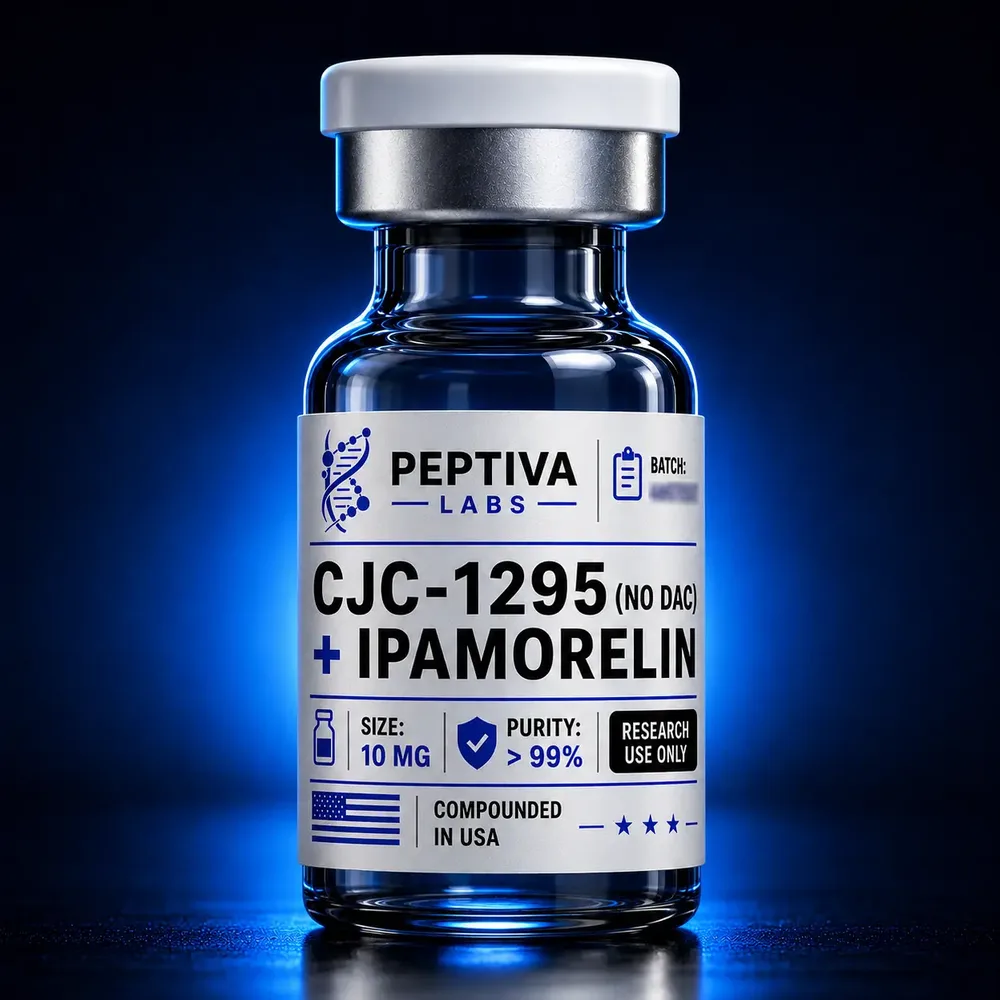
The CJC-1295 (no DAC) + ipamorelin blend is the canonical example of this design logic, combining a DPP-4-resistant GHRH fragment with the most selective of the peptide GHRPs. Peptiva Research Labs supplies this pairing as CJC-1295 no DAC + Ipamorelin for laboratory research, and tesamorelin as TESAMORELIN 10 MG for researchers characterizing a single GHRH analog in isolation. Whether the synergy observed in a given model reflects true pathway complementarity or partial somatostatin withdrawal is exactly the kind of question that the mechanistic cluster articles are built to explore.
Selecting a compound for a research question
The taxonomy translates directly into experimental design choices. A researcher interested in the cAMP/PKA arm, transcriptional effects, or GHRH-receptor pharmacology reaches for a GHRH analog. One interested in the calcium arm, ghrelin-receptor selectivity, or desensitization kinetics reaches for a GHRP. One interested in long-duration receptor occupancy or non-peptide pharmacokinetics reaches for MK-677. And one studying pathway complementarity reaches for a paired agent. The compound choice is downstream of the receptor question, which is why the two-receptor map is worth internalizing before touching a single vial.
Common points of confusion
Several recurring misconceptions trip up researchers new to the area, and clearing them up early prevents mis-designed experiments.
"GHRP" is a class, not a single compound
The term growth-hormone-releasing peptide refers to the whole family of synthetic ghrelin-receptor agonists, not to any one molecule. GHRP-2 and GHRP-6 carry the label in their names, but ipamorelin and hexarelin are equally members of the class by mechanism. Conversely, GHRH-releasing hormone analogs are an entirely different class hitting a different receptor, despite the confusingly similar acronym.
Secretagogues are not growth hormone
A secretagogue does not add growth hormone to a system; it acts on the cellular machinery that governs endogenous release. In a cell-free assay with no somatotrophs, a secretagogue produces no growth hormone at all, which is precisely why pituitary cells or somatotroph lines are indispensable to functional characterization.
DAC and no-DAC are not interchangeable
The presence or absence of the Drug Affinity Complex on CJC-1295 changes its duration profile by orders of magnitude and therefore changes which secretion pattern (transient pulse vs sustained tonic) a model will exhibit. Treating the two variants as one compound is a common and consequential error in experimental planning.
A GH result is not automatically an IGF-1 result
Because the two markers operate on different timescales, an agent that scores well on an acute GH endpoint will not necessarily score the same on an IGF-1 endpoint, and vice versa. Reporting one and assuming the other is a frequent shortcut that the divergent kinetics do not support.
Explore this research cluster
This pillar is the map; the territory is covered in the cluster articles below, organized by the question each one answers. Every article is written for in-vitro and preclinical research contexts only.
Receptor pharmacology and selectivity
Start with the receptor-level comparison in GHRH receptor vs GHS-R1a selectivity, which sets the binding and signaling foundations for everything else. For the cleanest single-agonist case study, the ipamorelin research overview examines what "clean" GHS-R1a agonism looks like in practice, and cortisol and prolactin cross-reactivity of GHRPs compares selectivity across the class.
Compound-by-compound profiles
Individual agents are dissected in their own references. The tesamorelin GHRH-analog overview and the CJC-1295 DAC vs no-DAC half-life comparison cover the GHRH side, while the GHRP-2 vs GHRP-6 comparison, the GHRP-2 overview, hexarelin vs ipamorelin, and MK-677 vs GHRP-6 cover the ghrelin-receptor side across peptide and small-molecule chemistry. The sermorelin overview and sermorelin vs CJC-1295 round out the GHRH side.
Mechanism and combination behavior
The rationale for co-stimulation is the bimodal model described above, and its flagship pairing is walked through in the CJC-1295 + ipamorelin blend overview.
Assay design and readouts
On the methods side, this guide covers cell backgrounds, pulsatility and IGF-1 readouts above, and the GHS-R1a desensitization and tachyphylaxis analysis covers repeated-exposure design. Terminology is untangled in the GHRP vs GHRH glossary, and the compounds themselves are in the research peptides catalog.
Research context and limitations
Everything described here reflects mechanistic and assay observations drawn from the preclinical and in-vitro literature on the somatotropic axis. The two-receptor framework, the class taxonomy, and the assay readouts are tools for designing and interpreting laboratory experiments, not statements about outcomes in any living human or animal. Signaling behavior characterized in isolated pituitary cells, immortalized lines, or perifusion systems does not translate directly to whole-organism physiology, and the literature contains meaningful variability across model systems, cell backgrounds, and exposure paradigms.
All compounds referenced in this guide are offered by Peptiva Research Labs strictly for in-vitro and preclinical laboratory research by qualified investigators. Each lot is HPLC/LC-MS verified and accompanied by a Certificate of Analysis. Nothing in this article is a medical, therapeutic, or veterinary claim, and no content here should be read as describing or endorsing use in humans or animals. Researchers are responsible for handling these materials in accordance with all applicable institutional and regulatory requirements.
Selected references
The peer-reviewed primary literature below underpins the mechanisms and figures discussed in this guide, provided for scientific reference and research context only. Inclusion does not constitute a therapeutic claim; all compounds referenced are supplied strictly for laboratory research use.
- Teichman SL, Neale A, Lawrence B, Gagnon C, Castaigne JP, Frohman LA. Prolonged stimulation of growth hormone (GH) and insulin-like growth factor I secretion by CJC-1295, a long-acting analog of GH-releasing hormone, in healthy adults. J Clin Endocrinol Metab. 2006;91(3):799-805. View source →
- Raun K, Hansen BS, Johansen NL, Thøgersen H, Madsen K, Ankersen M, Andersen PH. Ipamorelin, the first selective growth hormone secretagogue. Eur J Endocrinol. 1998 Nov;139(5):552-561. doi:10.1530/eje.0.1390552. PMID: 9849822. View source →
- Holst B, Cygankiewicz A, Halkjaer Jensen T, Ankersen M, Schwartz TW. High constitutive signaling of the ghrelin receptor--identification of a potent inverse agonist. Mol Endocrinol. 2003 Nov;17(11):2201-2210. doi:10.1210/me.2003-0069. PMID: 12907757. View source →
- Patchett AA, Nargund RP, Tata JR, Chen MH, Barakat KJ, Johnston DB, et al. Design and biological activities of L-163,191 (MK-0677): a potent, orally active growth hormone secretagogue. Proc Natl Acad Sci USA. 1995;92(15):7001-7005. doi:10.1073/pnas.92.15.7001 View source →
- Bodart V, Febbraio M, Demers A, McNicoll N, Pohankova P, Perreault A, Sejlitz T, Escher E, Silverstein RL, Lamontagne D, Ong H. CD36 mediates the cardiovascular action of growth hormone-releasing peptides in the heart. Circ Res. 2002;90(8):844-849. doi:10.1161/01.RES.0000016164.02525.B4 View source →
- Falutz J, Allas S, Blot K, Potvin D, Kotler D, Somero M, Berger D, Brown S, Richmond G, Fessel J, Turner R, Grinspoon S. Metabolic effects of a growth hormone-releasing factor in patients with HIV. N Engl J Med. 2007;357(23):2359-2370. doi:10.1056/NEJMoa072375 View source →