Short regulatory neuropeptides occupy a distinctive corner of the research-chemical landscape: molecules only a handful of residues long, derived from endogenous signaling fragments, yet studied for outsized effects on neurotrophic gene expression, stress-axis modulation, and central nervous system access. Nootropic peptides research in this class centers on two names that recur across the preclinical literature — Selank and Semax — alongside the parent molecules from which they were engineered. Understanding either one in isolation misses the larger point: both are products of a deliberate Soviet-era and Russian program to take a native peptide fragment, identify its bioactive core, and stabilize it against rapid enzymatic breakdown.
This guide is the hub for that cluster. Rather than re-deriving each compound in depth, it maps the shared taxonomy — the melanocortin/ACTH lineage that gave rise to Semax, the tuftsin lineage behind Selank — and connects the common experimental readouts researchers use across the group: BDNF and HSP70 expression, blood-brain-barrier permeability modeling, enzymatic (aminopeptidase) stability, and intranasal delivery in rodent models. Everything below is framed strictly for in-vitro and preclinical laboratory investigation. Nothing here describes human use, dosing, or therapeutic outcomes.
What makes a peptide "regulatory" and "nootropic" in the research literature
The term regulatory neuropeptide describes a short peptide that modulates signaling in the nervous system rather than acting as a classical neurotransmitter or a structural building block. In the research context these molecules are studied as tools: reagents added to cell cultures or administered to animal models to perturb a pathway and observe the downstream response. "Nootropic" is the loosest of the descriptors — in the preclinical literature it flags compounds investigated for effects on learning, memory consolidation, or cognitive-task performance in rodent paradigms, not a validated pharmacological category with a settled mechanism.
It helps to separate what these labels do and do not assert. "Regulatory" is a statement about origin and mode of action: the molecule descends from an endogenous signaling peptide and modulates an existing pathway rather than introducing a foreign scaffold. "Nootropic" is a statement about the experimental question being asked — namely, whether administration shifts performance on a memory or attention task in an animal model. Neither term implies a demonstrated benefit, and neither maps onto a regulatory drug classification. In the research literature they function as search terms and framing devices, useful for grouping compounds that share a study design, not as claims about outcomes.
The distinction matters when reading across studies. A paper may report that a peptide altered BDNF transcription in cultured neurons and, separately, that treated animals performed differently on a memory task. Those are two different classes of observation — a molecular measurement and a behavioral one — and the "nootropic" framing tempts readers to collapse them into a single causal story. In careful work the two are kept separate and the link between them is treated as a hypothesis to be tested, not a conclusion. Part of what this hub does is keep those layers distinct: the molecular readouts are catalogued under the shared-endpoint articles, while the behavioral paradigms that supply the "nootropic" label are treated as their own methodology with their own failure modes. Conflating the two is the most common interpretive error in this literature, and the cluster is structured to make that conflation harder rather than easier.
Three properties recur across the cognitive/regulatory neuropeptide class and organize almost every study design:
- Endogenous origin. Each compound traces to a naturally occurring peptide — a fragment of adrenocorticotropic hormone (ACTH) or of the immunomodulatory tetrapeptide tuftsin. This origin is why researchers describe them as "regulatory" rather than xenobiotic.
- Engineered stability. Native short peptides are cleaved within minutes by serum and brain aminopeptidases. The synthetic analogs add terminal residues or modifications specifically to slow that cleavage and extend the window over which a measurable effect can be observed.
- Central access via a peripheral route. A recurring experimental question is how a small, charged peptide reaches the CNS. Intranasal administration in rodents is the dominant model, and blood-brain-barrier permeability assays are a standard characterization step.
Because these three threads run through the whole class, the deeper articles in this cluster each take one thread and follow it. For the head-to-head disambiguation of the two flagship peptides, see Selank vs Semax: a comparative research profile. For the neurotrophic readout that both share, see the BDNF expression research models reference. This pillar stays at the taxonomy level and points you to the right sub-topic. Readers who want the underlying primary-structure detail — exact residue order, terminal chemistry, and how sequence choices map to function — will find it in the Selank and Semax sequence and structure notes, which this hub summarizes but does not reproduce residue by residue.
The two lineages: ACTH/melanocortin and tuftsin
The cleanest way to organize this class is by ancestry. Two distinct parent molecules seeded the family, and the engineering logic differs between them.
The ACTH / melanocortin lineage (Semax)
Adrenocorticotropic hormone is a 39-residue peptide of the melanocortin system. Decades of work — much of it in the neuropeptide tradition associated with De Wied and later Russian groups — established that a short internal fragment, ACTH(4-10), retains behavioral and neurotrophic activity uncoupled from the hormone's corticotropic (steroid-releasing) function. Semax was built from the N-terminal part of that fragment: it joins ACTH(4-7) (Met-Glu-His-Phe) to a C-terminal Pro-Gly-Pro tripeptide that resists proteolysis, giving the heptapeptide Met-Glu-His-Phe-Pro-Gly-Pro. The result is an analog studied for effects on neurotrophic factor expression and CNS signaling without the endocrine activity of the parent hormone. The native fragment was a poor research tool on its own because short unprotected peptides are cleared within minutes by exopeptidases; the Pro-Gly-Pro extension is what makes Semax practical to study. Research material is supplied as Semax 10 mg.
The tuftsin lineage (Selank)
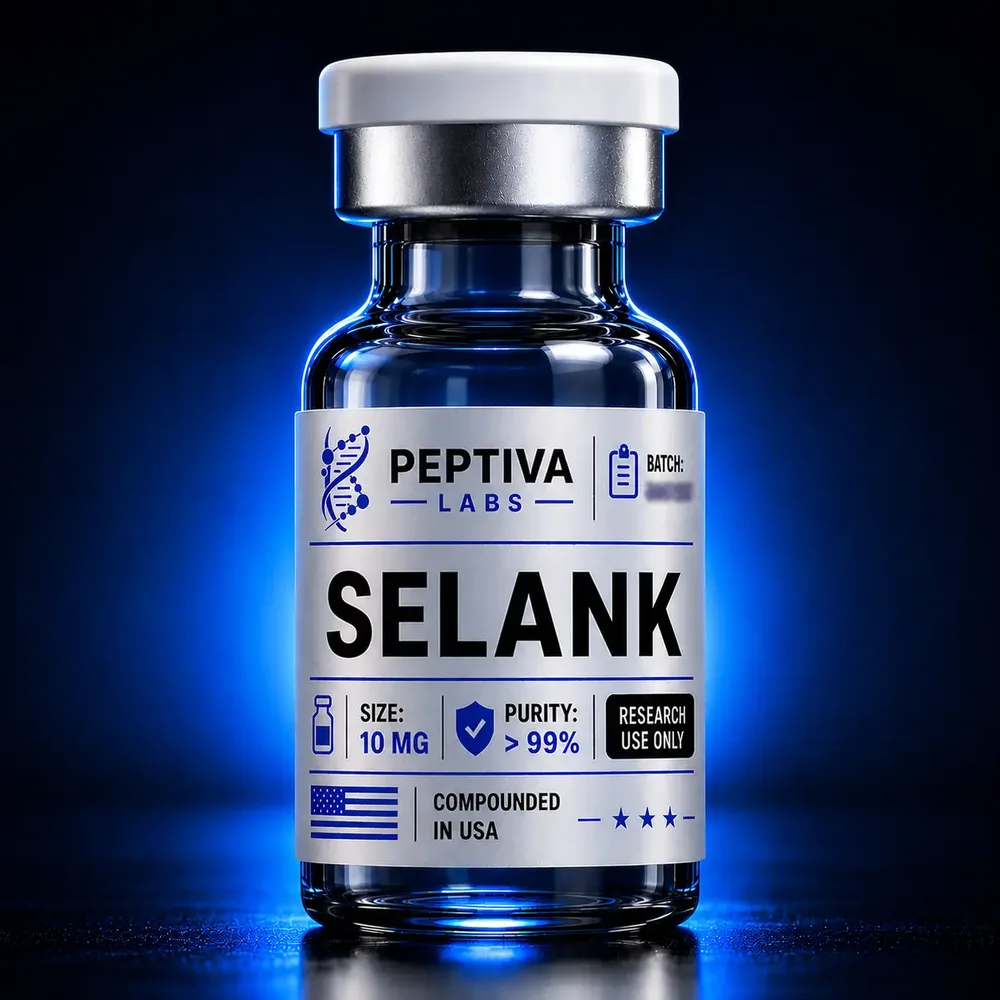
Tuftsin is a natural tetrapeptide (Thr-Lys-Pro-Arg) cleaved from the Fc region of immunoglobulin G, historically characterized for its immunomodulatory and phagocytosis-stimulating activity. Selank is a synthetic tuftsin analog — sometimes referenced by the developmental code TP-7 — built by extending the tuftsin sequence with a C-terminal Pro-Gly-Pro motif, the same stabilizing strategy applied to Semax. That added sequence is thought to slow enzymatic degradation and shift the molecule's studied profile toward anxiolytic-like and neuromodulatory readouts in animal models. The resulting sequence is Thr-Lys-Pro-Arg-Pro-Gly-Pro. Studies of Selank in rodent models have examined GABAergic modulation, monoamine turnover and the expression of genes such as BDNF, alongside the immunomodulatory activity inherited from tuftsin. Research material is supplied as Selank 10 mg.
Note the convergent design: two unrelated parent peptides, both stabilized by the same Pro-Gly-Pro C-terminal extension. That shared trick is a large part of why Selank and Semax are studied side by side despite having no sequence homology at their cores. The convergence is instructive in its own right. When two independent engineering efforts, starting from a hormone fragment and an antibody fragment respectively, arrive at the same terminal motif, it signals that the motif is solving a shared problem — proteolytic vulnerability at the peptide terminus — rather than contributing to any compound-specific activity. That is why stability, not efficacy, is the connective tissue of this class, and why the taxonomy below organizes members by parent molecule and modification rather than by any claimed effect.
Taxonomy at a glance
The table below lays out the class as researchers typically catalog it. Sequences are the commonly cited research forms; treat them as reference points for reagent identity, not as any kind of preparation instruction.
| Peptide | Parent molecule | Lineage | Core research sequence (cited form) | Stabilizing modification | Primary studied readouts |
|---|---|---|---|---|---|
| Semax | ACTH(4-10) fragment | Melanocortin / ACTH | Met-Glu-His-Phe-Pro-Gly-Pro | C-terminal Pro-Gly-Pro extension | BDNF/NGF expression, neuroprotection models, cognitive-task paradigms |
| N-acetyl Semax | Semax | Melanocortin / ACTH | Ac-Met-Glu-His-Phe-Pro-Gly-Pro | Added N-terminal acetylation | Extended enzymatic stability, same neurotrophic readouts |
| Selank | Tuftsin (TKPR) | Tuftsin / IgG-derived | Thr-Lys-Pro-Arg-Pro-Gly-Pro | C-terminal Pro-Gly-Pro extension | Anxiolytic-like behavior, GABA/monoamine systems, BDNF, immune markers |
| ACTH(4-10) | ACTH (native) | Melanocortin / ACTH | Met-Glu-His-Phe-Arg-Trp-Gly | None (native, rapidly cleaved) | Historical behavioral/neurotrophic baseline |
| Tuftsin | IgG Fc region | Tuftsin / IgG-derived | Thr-Lys-Pro-Arg | None (native, rapidly cleaved) | Phagocytosis, immunomodulation baseline |
Several sub-topics branch directly off this table. The N-terminal acetylation strategy — how acetylation and amidation are studied to blunt aminopeptidase cleavage — is examined in the comparative profile and, in detail, in the N-acetyl Semax stability work. The parent fragments, ACTH(4-10) and native tuftsin, were unsuitable on their own for the same reason: rapid enzymatic clearance. Read across a single row and you see one compound's identity; read down the "stabilizing modification" column and you see the engineering theme of the entire family.
The shared research readouts
What ties this class together experimentally is a small, recurring set of endpoints. If you are reading a study on any of these peptides, it almost certainly measures one or more of the following. Grouping the readouts this way is deliberate: because the compounds share so much study design, the most efficient way to understand the literature is by endpoint rather than by compound, and each endpoint has a dedicated reference article that this hub feeds into.
BDNF and neurotrophic gene expression
Brain-derived neurotrophic factor is the single most common molecular readout in this literature. Both Selank and Semax have been investigated in cell-based and rodent models for their influence on BDNF expression and downstream neurotrophic signaling, and the BDNF/TrkB axis serves as a convenient, quantifiable proxy for "did the peptide engage a neuroplasticity-relevant pathway." Assays range from qPCR and ELISA on hippocampal tissue to reporter constructs in cultured neurons. Because this readout is central and methodologically involved, it has its own reference: BDNF expression research models for regulatory neuropeptides. That article covers why the endpoint is chosen, how it is measured, and its interpretive limits — material this pillar deliberately does not duplicate.
HSP70 and cytoprotective stress-response markers
Beyond BDNF, several studies track heat-shock protein 70 (HSP70) and related cytoprotective markers as indicators of a cellular stress-response engagement, particularly in ischemia and oxidative-stress models. HSP70 induction is reported in some Semax investigations as part of a neuroprotection-model characterization, and it is often measured alongside BDNF to distinguish a neuroplasticity signal from a broader stress-adaptation signal. HSP70 is typically measured by western blot, ELISA or qPCR in neuronal or glial cells exposed to an oxidative, excitotoxic or oxygen-glucose-deprivation challenge. Because HSP70 rises in response to stress itself, an increase is only interpretable against a stressor-only control and a time course, since the induction is transient. As with every readout here, these are molecular observations in preclinical systems, not evidence of any protective effect in humans.
Blood-brain-barrier permeability
A short, cationic peptide reaching CNS targets is not a given, so BBB access is a standing research question for the whole class. In-vitro models — endothelial monolayers on Transwell inserts, parallel-artificial-membrane assays, and co-culture systems — are used to estimate permeability, complemented by in-vivo distribution studies in rodents. The barrier-transport angle, including how the small size and charge of these peptides interact with paracellular and carrier-mediated routes, is developed separately in the blood-brain-barrier research models discussion so it is not re-treated here.
Enzymatic stability and half-life
The entire engineering rationale of this class is proteolytic resistance, so stability assays are foundational. Researchers incubate peptides in serum, plasma, or brain homogenate and quantify intact-parent decay by LC-MS or HPLC over time, mapping which residues are cleaved first. The Pro-Gly-Pro extension and N-terminal acetylation are both evaluated this way. Aminopeptidases and dipeptidyl peptidases dominate the clearance of short unprotected peptides, which is why proline placement and N-terminal capping are the main stabilizing levers. Half-life is defined as the time for the intact parent to fall to half its starting level in a stated matrix and temperature, and the general handling side is covered in the reconstitution and stability guide. Consistent, purity-verified reagents matter enormously for these measurements — degradation kinetics are only interpretable if the starting material is well characterized, which is why lot-specific COA and HPLC/LC-MS verification are baseline expectations for research-grade material.
Intranasal delivery models
Intranasal administration is the dominant delivery paradigm in rodent studies of both peptides, studied partly for direct nose-to-brain transport hypotheses and partly as a non-invasive route that bypasses first-pass metabolism. Study designs frequently pair an intranasal route with the BBB and stability questions above, since all three bear on the same underlying problem: getting an intact peptide to a central target. The route-specific methodology — anatomical considerations in the rodent nasal cavity, formulation variables, and how nose-to-brain transport is inferred — is covered in intranasal delivery research models for regulatory neuropeptides.
Behavioral and cognitive task readouts
Molecular endpoints only become "nootropic" in the loose research sense when they are paired with a behavioral outcome. Rodent paradigms — passive-avoidance, Morris water maze, elevated-plus-maze for anxiety-like behavior, novel-object recognition — are the assays that put the "cognitive" label on these compounds, and they are notoriously sensitive to handling, strain, and protocol. Because behavioral data are where over-interpretation is easiest, well-designed studies use blinded scoring, counterbalanced testing order, locomotor-activity controls (so a change in movement is not mistaken for a change in memory or anxiety), and adequate group sizes. This hub simply flags that a molecular readout without a behavioral correlate, or a behavioral result without a molecular anchor, tells only half the story.
Explore this research cluster
The cluster is intentionally partitioned so that no two articles cover the same ground; each owns a non-overlapping slice, and this hub is the map. It helps to see the sub-topics grouped by the kind of question they answer rather than as a flat list. The four groupings below organize every article in the cluster.
Individual compound profiles
Start here if your question is about one molecule as a reagent. The lineage section above covers each flagship compound — origin, sequence and the readouts most associated with it. When the practical question is which of the two to design an experiment around, the Selank vs Semax comparative profile sets them side by side, and Selank vs Semax: research peptide comparison gives a shorter summary.
Lineage and structure
This group answers "where did the molecule come from and what is it made of." The lineage section above traces the two parent peptides forward to their engineered analogs, while the Selank and Semax sequence and structure notes and the N-acetyl Semax stability work handle primary-structure detail and the specific chemistry of terminal modification.
Shared experimental readouts
These articles are organized by endpoint, not by compound, and apply across the whole class: BDNF expression research models, synaptic plasticity and LTP assays, and monoamine transporter binding assays; HSP70 and behavioral readouts are covered in this guide. Read the one that matches the measurement you are planning or trying to interpret.
Delivery, access, and stability
The last group covers how an intact peptide reaches and persists at a central target: blood-brain-barrier research models, intranasal delivery research models, and enzymatic stability, covered above and in the reconstitution and stability guide. These three questions are entangled in most study designs, which is why they sit together. To browse the compounds themselves, see the research peptides catalog.
How the pieces fit: a worked navigation example
To show how the hub-and-spoke structure is meant to be used, consider a concrete research scenario. Suppose an investigator is planning an in-vitro study to compare how Selank and Semax influence neurotrophic signaling in a cultured hippocampal model, and wants to build the experiment on solid characterization.
The natural path through this cluster runs across several spokes. Reagent selection begins with the two individual overviews and the comparative profile to fix which compounds and forms to use. Endpoint design draws on the BDNF expression models reference for the primary readout and, if a stress-adaptation control is wanted, the HSP70 readout described above. Because degradation in culture medium can confound a neurotrophic signal, a media-stability check tells you how long the peptide can be expected to persist in the assay. Sequence identity for both compounds is confirmed against the structure notes. No single article carries the whole workflow; the hub exists precisely to route each question to the spoke that answers it.
Reagent handling and laboratory preparation notes
Regardless of which compound a study targets, the practical handling considerations are similar for lyophilized short peptides. These notes concern laboratory reagent preparation only.
Reconstitution math (abstract, laboratory framing)
Lyophilized peptides are typically reconstituted for in-vitro work with bacteriostatic or sterile water, and the relevant calculation is a simple concentration relationship. For a vial containing a mass m of peptide dissolved in a volume V of solvent, the stock concentration is m / V. As an illustration, dissolving a 10 mg vial in 2 mL yields a 5 mg/mL stock (5000 µg/mL); a working solution at a target µM concentration is then derived from the peptide's molar mass. Selank (MW ≈ 751 g/mol) and Semax (MW ≈ 813 g/mol) differ enough that the same mass produces different molar stocks, which matters when normalizing across compounds in an assay. To convert a mass concentration to molarity, divide by molar mass: a 5 mg/mL Selank stock is roughly 6.7 mM, whereas the same 5 mg/mL of Semax is closer to 6.1 mM, a difference that compounds when serial dilutions target a fixed µM endpoint. Compatible reconstitution solvent such as BAC WATER 3 ML is a standard bench item for this step. None of this constitutes a dosing protocol — it is dilution arithmetic for preparing a laboratory stock.
Storage and stability
Lyophilized short peptides are generally most stable stored cold, dry, and protected from light; reconstituted solutions are far more labile and are typically kept refrigerated and used within a limited window, with repeated freeze-thaw cycles minimized. Aliquoting a reconstituted stock into single-use volumes is a common way to avoid the freeze-thaw problem, since each cycle can nick a fraction of the intact peptide and quietly shift the effective concentration. Because these compounds are studied precisely for their degradation kinetics, sloppy storage undermines the very measurements a stability study is trying to make.
Reagent identity and purity
For any of the readouts above to be interpretable, the identity and purity of the material must be established. Research-grade preparations should carry lot-specific analytical documentation — HPLC and mass-spectrometry data confirming sequence identity and quantifying purity — so that an observed effect can be attributed to the intended peptide rather than a truncation product or contaminant. This is exactly the concern the enzymatic-stability section raises in reverse: you cannot study controlled degradation if uncontrolled degradation is already present in the starting vial. A peptide that arrives partially cleaved will produce a stability curve that starts from the wrong baseline and a neurotrophic readout that cannot be cleanly attributed, which is why analytical documentation is not a formality but a precondition for the entire experimental program described here.
Where to find the individual compounds
Within this catalog, the two flagship members of the class are stocked as characterized research reagents: SELANK 10 MG and SEMAX 10 MG. Each is intended solely as a laboratory reference material for the kinds of in-vitro and preclinical investigations described above, and each ships with the lot-specific analytical documentation the purity discussion above treats as non-negotiable. For the wider set of compounds beyond the cognitive/regulatory class, see the research peptides catalog.
Research context and limitations
Everything described in this guide pertains to laboratory research use only. Selank, Semax, their parent molecules, and every readout discussed here have been characterized in cell-based systems and animal models; the preclinical literature reports associations and mechanisms, not established outcomes in humans. Nothing on this page is a medical claim, a statement of safety or efficacy, or any form of dosing guidance for people or animals. The peptides referenced are not approved drugs and are not intended for diagnosis, treatment, cure, or prevention of any condition.
Where this article attributes findings, it does so to the preclinical literature generally. Readers designing experiments should consult primary sources directly, verify sequence and molar-mass values against analytical documentation for their specific lot, and treat the taxonomy here as an orientation map rather than a substitute for the underlying studies. The hub-and-spoke organization above is meant to route a research question to the article that answers it in depth; it is not a claim that the class as a whole shares any single validated effect. Materials described are provided strictly for qualified researchers and laboratories, for in-vitro and preclinical research use only, and not for human or veterinary use.
Selected references
The peer-reviewed primary literature below underpins the mechanisms and figures discussed in this guide, provided for scientific reference and research context only. Inclusion does not constitute a therapeutic claim; all compounds referenced are supplied strictly for laboratory research use.
- Dolotov OV, Karpenko EA, Inozemtseva LS, Seredenina TS, Levitskaya NG, Rozyczka J, Dubynina EV, Novosadova EV, Andreeva LA, Alfeeva LY, Kamensky AA, Grivennikov IA, Myasoedov NF, Engele J. Semax, an analog of ACTH(4-10) with cognitive effects, regulates BDNF and trkB expression in the rat hippocampus. Brain Research. 2006;1117(1):54-60. doi:10.1016/j.brainres.2006.07.108 View source →
- Dolotov OV, Karpenko EA, Seredenina TS, Inozemtseva LS, Levitskaya NG, Zolotarev YA, Kamensky AA, Grivennikov IA, Engele J, Myasoedov NF. Semax, an analogue of adrenocorticotropin (4-10), binds specifically and increases levels of brain-derived neurotrophic factor protein in rat basal forebrain. Journal of Neurochemistry. 2006;97 Suppl 1:82-86. doi:10.1111/j.1471-4159.2006.03658.x</canonical> <parameter name="url">https://pubmed.ncbi.nlm.nih.gov/16635254/ View source →
- Inozemtseva LS, Karpenko EA, Dolotov OV, Levitskaya NG, Kamensky AA, Andreeva LA, Grivennikov IA. Intranasal administration of the peptide Selank regulates BDNF expression in the rat hippocampus in vivo. Doklady Biological Sciences. 2008;421:241-243. doi:10.1134/S0012496608040066. PMID: 18841804. View source →
- Kost NV, Sokolov OYu, Gabaeva MV, Grivennikov IA, Andreeva LA, Myasoedov NF, Zozulya AA. Semax and Selank inhibit the enkephalin-degrading enzymes from human serum. Bioorganicheskaia Khimiia (Russian Journal of Bioorganic Chemistry). 2001;27(3):180-183. doi:10.1023/A:1011373002885. PMID: 11443939. View source →
- Adan RA, Gispen WH. Melanocortins and the brain: from effects via receptors to drug targets. Eur J Pharmacol. 2000 Sep 29;405(1-3):13-24. doi:10.1016/s0014-2999(00)00537-9. PMID: 11033310. View source →